Inside the Gemini factory
Google Cloud has outlined the Gemini factory, a co-innovation initiative designed to help enterprise software partners move from an initial concept to agentic solutions listed on Google Cloud Marketplace. The program builds on the new unified Gemini experience, which lets enterprises bring third-party partner capabilities directly into Gemini through standardized connectors spanning the Model Context Protocol (MCP), Agent-to-Agent (A2A) runtimes, and REST APIs, alongside emerging declarative skills and plugins.
For independent software vendors (ISVs), this unified architecture creates an opportunity to embed domain-specialized intelligence, regulated workflows, and live systems of record into enterprises' daily work. Google Cloud notes, however, that turning a use case into an enterprise-ready integration often stalls on engineering friction: choosing the right extensibility primitive, wiring authentication, orchestrating multi-step tool execution, and rendering inline interactive experiences.
The Gemini factory aims to remove those bottlenecks through hands-on workshops in global technology hubs, including San Francisco, New York City, Sunnyvale, London, Paris, Tel Aviv, and Tokyo, where Google Cloud specialists work alongside partner teams. According to Google Cloud, the program helps partners choose the right agentic architecture across MCP connectors, skills, plugins, and autonomous agents; move from an initial use case to a production integration in days rather than months; and accelerate customer activation through funding incentives and go-to-market support.
Choosing the right architecture: agents, MCPs, skills, and plugins
Google Cloud says earlier generations of enterprise AI often relied on third-party integrations that operated as isolated top-level agents, forcing employees to leave their workflow. Partners entering the Gemini factory evaluate how their capabilities plug into Gemini across four complementary architectural primitives:
- Model Context Protocol (MCP) connectors: the foundational data and tool pipe for exposing external APIs, search, and CRUD operations to Gemini as callable tools registered in the Agent Registry in the Gemini platform.
- Declarative Skills (.md): open Markdown configurations stored in the Skills Registry that equip Gemini with domain-specific instructions, operational guardrails, and repeatable multi-step workflows across connectors.
- Plugins: the composite packaging and governance primitive in Gemini and Google Cloud Marketplace that bundles one or more connectors and skills into a single turnkey solution for IT administrators to govern and Gemini users to invoke.
- AI agents (A2A): for enterprise ISVs whose value lies in proprietary algorithms, regulated workflows, or strict compliance rules, standalone A2A agents run in an isolated partner environment while plugging into Gemini as callable connectors, keeping intellectual property protected, guaranteeing deterministic execution sequences, and maintaining tamper-proof audit trails.
Rather than forcing developers into a single mold, Gemini unifies all four primitives into a coherent enterprise fabric, passing shared session context into partner connectors and chaining outputs across the enterprise ecosystem.
From use case to production
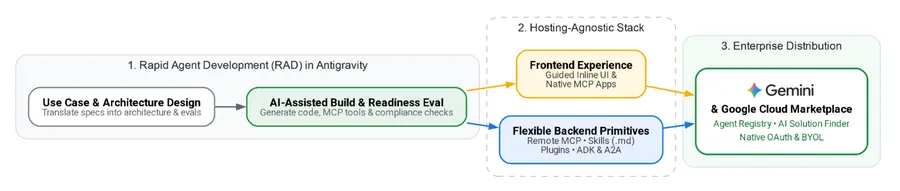
Once the architectural pattern is defined, the Gemini factory compresses what Google Cloud describes as months of integration work into an AI-assisted engineering pipeline that brings partner development teams and Google Cloud experts together. This execution velocity is powered by three core capabilities in the Gemini platform:
- Antigravity and AI-assisted builder workflows: developers build and govern solutions in Antigravity, an AI-first development environment. Using pre-built Rapid Agent Development (RAD) skills and AI-assisted workflows, partner teams translate use-case specifications into working architectures, scaffold remote MCP connectors or agent runtimes, author declarative .md skills, and run automated pre-ingestion validation harnesses.
- Flexible backend primitives (MCP, skills, plugins, and ADK): for most integrations, teams expose platform APIs via a hosting-agnostic Remote MCP Connector, on Cloud Run or their existing cloud, and layer on declarative skills bundled into a turnkey plugin. When a use case requires closed-IP models or strict deterministic execution, partners use the Google Agent Development Kit (ADK) and the A2A protocol to expose their runtime as a callable connector in the Agent Registry.
- Inline adaptive experiences (native MCP apps): instead of redirecting users to external portals or maintaining complex custom interfaces, partner integrations use native MCP apps and guided inline components to stream rich, context-aware visual canvases directly in Gemini while chaining outputs across Google Workspace and other enterprise connectors.
From working prototype to marketplace distribution
Google Cloud structures the Gemini factory as an end-to-end commercial runway in three stages:
| Stage | Program pillar | Partner benefit |
|---|---|---|
| 1. Build | Seed credits | Upfront scoped credits to offset build and porting costs, consumption-based performance credits as partners scale, and scoped engineering support to accelerate development |
| 2. Launch | Cloud Marketplace | Direct publishing to Google Cloud Marketplace with streamlined billing, procurement, and enterprise integration for visibility across global enterprise and mid-market accounts |
| 3. Scale | Co-marketing and GTM | Custom co-marketing and launch assets, social promotion, PR kits, launch spotlight campaigns, and Google-funded campaign packages for top-performing partners |
Three additional elements underpin the commercial model:
- Enterprise deployment architecture: regardless of whether a partner builds a skill, plugin, MCP server, or A2A agent, the architecture is designed to keep customer onboarding frictionless and partner IP secure. Gemini users access the partner integration through native OAuth, Dynamic Client Registration (DCR), and streamlined Bring Your Own License (BYOL) flows, while the partner maintains backend security, data sources, and proprietary tooling within its own project perimeter.
- Built-in discoverability: partner solutions are published directly to Google Cloud Marketplace and featured in AI Solution Finder, giving enterprise customers a central place to discover validated MCP connectors, plugins, and agents and letting IT administrators configure and govern them in Gemini.
- Incentives and go-to-market: qualified solutions unlock seed credits upon Marketplace publishing and performance credits to offset operational inference costs, paired with GTM assets and sales enablement.
Featured partners
Google Cloud says recent Gemini factory cohorts, previously referred to as the Agent Factory, have already produced a wave of industry-specific agents, with nine software partners deploying production-grade solutions in days.
Aily Labs — Aily Decision Intelligence Agent. The agent unifies 360-degree enterprise performance metrics to deliver predictive business diagnostics and strategic recommendations for executive decision-makers. It interrogates operational and financial datasets to forecast performance trends, identify supply disruptions, and guide resource allocation through a mobile-first interface. Reynaldo Espana, VP of Engineering at Aily Labs, said the Agent Factory workshop was "an incredible catalyst" that let the team wire predictive reasoning models into the Gemini Enterprise runtime, activating the Aily Super Agent "in record time" while orchestrating thousands of specialized agents across business domains.
FlowX — Capital Markets Document Reconciliation Agent. The agent streamlines financial operations including institutional document extraction, multi-party reconciliation, and loan pack completeness audits. Using document intelligence and Kubernetes-backed agent runtimes, it cross-checks contracts, regulatory filings, and credit documentation to flag discrepancies in real time. Serban Chiricescu, Founder and CTO of FlowX.AI, said the team transitioned from raw use cases to a functional prototype in a single workshop without compromising enterprise compliance.
Klarvant — Digital Governance Analyst Agent. The agent provides outside-in discovery and analysis of an enterprise's external namespace: post-quantum readiness, certificate and TLS hygiene, email security, supply-chain risk, and external exposure. It tracks post-quantum migration endpoint by endpoint, matches supplier and dependency events to the points where they touch the estate, and answers plain-language questions with audit-ready evidence and custom dashboards. Endre Fehn, CTO of Klarvant, said Gemini's ability to reason over complex technical evidence and explain it in plain language makes it "the bridge between our intelligence and the people accountable for it."
NextLM — AI Prospecting Agent. Powered by the Savant model family, the agent ranks the B2B accounts and buyers most likely to convert using behavioral data across more than 300 million companies, 370 million professionals, and 1.3 billion tracked news articles. Each customer gets an isolated model further trained on its own closed-won and closed-lost data. The agent hands ranked accounts and buyer context to research, outreach, and CRM connectors inside Gemini. Chris Anzalone, Founder and CEO of NextLM, said engineers used the RAD framework to go from an initial architecture diagram to a working prospecting agent in under 24 hours.
Optimizely — Mark Marketing Calendar Deck Builder Agent. The agent converts marketing strategies, campaign timelines, and experimentation roadmaps into executive-ready slide decks and visual briefs. Grounded in campaign performance metrics and content repository data, it generates unified omnichannel schedules and tracks milestone delivery. Kevin Li, SVP Product at Optimizely, said the team used Gemini and Vertex AI Vector Search to build the agent in one intensive day.
Ping Identity — PingID Device Management Agent. The agent lets employees manage their own MFA devices by asking. When someone gets a new phone, it displays a live PingID pairing QR code with real-time status directly in Gemini, rendered with A2UI. Employees can list, rename, set a default, or remove devices without opening a portal or filing a help desk ticket, replacing the over-the-phone identity check that social engineering attacks exploit. Loren Russon, SVP of Product and Technology at Ping Identity, said the experiences run natively in Gemini using ADK, A2A, and A2UI, with every action scoped to the user, confirmed by a person, and accountable.
Sinch — Sinch RCS Messaging Agent. The agent lets enterprises create and manage RCS business agents, draft interactive messaging campaigns from natural-language prompts, execute rich RCS broadcasts, and monitor delivery reports. It is built with Gemini and Sinch's carrier infrastructure. Antoine Sein, Senior Engineering Manager for Developer Experience and Agent Experience at Sinch, said the program accelerated the company's timeline from prototype to a verified Marketplace listing, covering enterprise authentication, RCS agent provisioning, prompt-based campaign drafting, and real-time delivery reporting.
THG Ingenuity — Shopping Assistant Insights Agent. The agent converts shopper conversations into commercial insights grounded in BigQuery analytics. It tracks shopper demand, assistant performance, and customer friction while maintaining strict data privacy, highlighting opportunities for commercial leaders to stock, promote, or fix based on real user interactions. Jo Drake, CTO of THG Ingenuity, said the collaborative environment accelerated development and deepened the company's understanding of the Agent Marketplace.
Xiatech — Xfuze Order Intake Agent. The agent automates multichannel commerce order processing, exception triage, and inventory reconciliation across enterprise systems. Powered by Xiatech's Xfuze integration platform and BigQuery analytics, it identifies supply chain anomalies, resolves fulfillment errors, and gives commercial operators conversational visibility into real-time order-to-cash health. Jonathan Summerfield, Founder and CEO of Xiatech, said the team used the Antigravity IDE and RAD developer skills to build what he described as a first-of-its-kind agentic application, multiple agents in one, in 24 hours.
The road ahead
Google Cloud frames the program around three pillars: end-to-end co-engineering with rapid architecture design, AI-assisted development, and automated readiness testing in Antigravity; full-spectrum extensibility across deterministic A2A agents, standardized MCP connectors, declarative skills, and turnkey plugins; and marketplace discovery backed by seed credits, performance incentives, and joint go-to-market support. The company says the Gemini factory collapses the journey from an initial whiteboard concept to a verified Google Cloud Marketplace listing into a matter of days, and directs interested companies to the Google Cloud Marketplace, AI Solution Finder, or their Google Cloud Partner team to begin building.