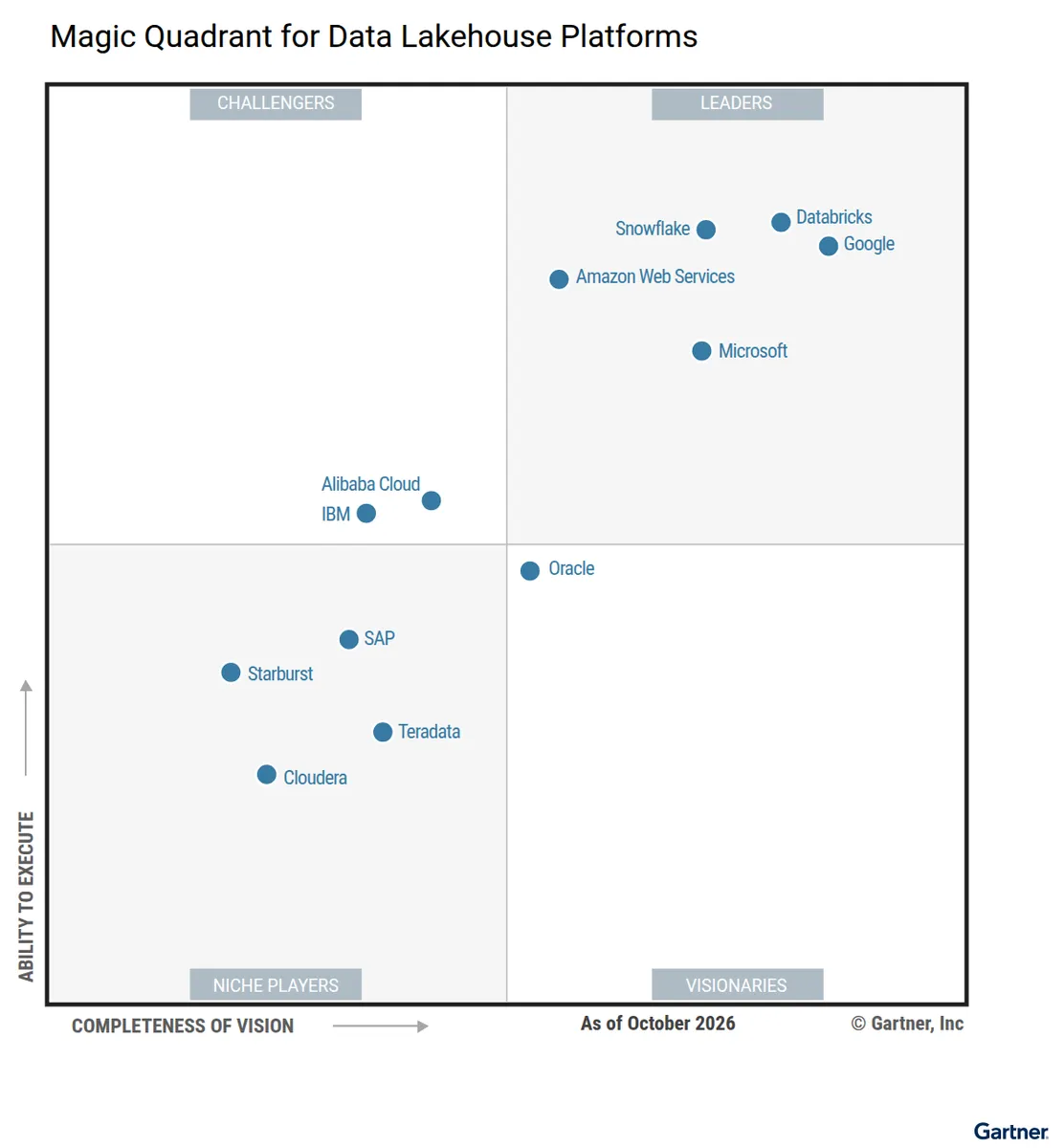
Gartner has named Google Cloud a Leader, positioned furthest in vision, in its first-ever Magic Quadrant for Data Lakehouse Platforms. In Google's view, the recognition validates a change its customers already experience daily: in the agentic era, the enterprise lakehouse is no longer a passive data repository but a foundation on which agents reason and act across all of an organization's data.
The lakehouse originally emerged to bring data warehouse reliability to open, low-cost storage, but the benchmark defining the category is shifting. According to Google, leading enterprises are moving quickly from static reporting to autonomous AI agents that monitor operations, flag anomalies and execute business workflows in real time. Supporting that requires a platform where thousands of agents can read, reason and act continuously across enterprise data without moving it first — something, the company argues, that fragmented data stacks burdened by brittle pipelines, duplicated storage and disjointed governance were never designed to deliver at agentic scale.
Google says it engineered its borderless Lakehouse at every layer of the stack to remove that complexity and hidden cost. Designed specifically for agents to reason across petabyte-scale data, it unifies the data estate across clouds, data platforms and SaaS applications so that agents can be grounded in governed business context and Gemini can be brought directly to the data.
Activating a distributed data footprint in place
For most organizations, Google says, the biggest barrier to scaling AI is that enterprise data is spread across multiple clouds, operational databases and SaaS platforms, and moving it all into one physical location is slow, expensive and introduces governance risk. Built on open Apache Iceberg, the borderless Lakehouse acts as a bridge across that distributed environment, connecting multi-cloud, SaaS and operational data into a single governed fabric. Organizations can start analyzing datasets across AWS, Azure and Google Cloud without costly copies or complex migrations, with three stated benefits:
- Openness without performance trade-offs: analytics and AI run in BigQuery and Managed Service for Apache Spark directly on open Iceberg tables, at price-performance similar to native storage.
- High-speed cross-cloud economics: Cross-Cloud Interconnect and intelligent caching establish private, high-speed paths to AWS and Azure; by caching only the active data blocks a query touches, the lakehouse serves repeated lookups locally, protecting data residency and eliminating variable egress fees.
- Vertically integrated security and governance: credential vending in the Lakehouse runtime catalog is intended to carry security policies with agents wherever the data resides.
German banking group Commerzbank built its AI strategy on the borderless Lakehouse and Apache Iceberg to deploy AI agents across contact centers and marketing while satisfying strict European banking regulations. According to Google, a unified foundation now powers AI across the bank: the marketing team cut campaign production times from weeks to days, and contact center agents receive verified next steps within seconds.
Agents need business context, not just access
An autonomous agent is only as accurate as the business context it understands, Google argues. The lakehouse automatically harvests metadata from storage layers and passes it to context engines; the Lakehouse runtime catalog integrates directly with Knowledge Catalog, which Google describes as a universal context engine that autonomously aggregates and curates metadata and semantic context from all sources, inside and outside Google, enriches them to extract meaning and serves unified context to the agents an organization builds and uses. Highlighted capabilities include:
- Unified aggregation across the enterprise: with the general availability of expanded aggregation in Knowledge Catalog, organizations can unify metadata, metrics and business logic across Looker, dbt and BigQuery in a single governed semantic layer that prevents metric drift across multi-cloud assets.
- Turnkey agent grounding: Gemini grounded with Knowledge Catalog and context sets, both in preview, lets teams package curated metrics and instructions into token-efficient bundles that agents consume via standard APIs and the Model Context Protocol.
- No-code context optimization: a new studio experience in Knowledge Catalog, in preview, gives data stewards an agentic-first, no-code environment to resolve definition gaps and securely govern the exact context agents are authorized to access. Delivering only the most relevant context is meant to reduce latency, lower token costs and prevent expensive reasoning loops.
Bloomberg Media grounded its conversational queries directly in the Knowledge Catalog semantic layer and, according to Google, achieved a 63% improvement in query accuracy while eliminating hallucinations across its business teams.
Business context is only half the equation, Google says: because agents act rather than just analyze, the analytical lakehouse and operational databases must behave as one system. BigQuery, Managed Service for Apache Spark, Spanner and AlloyDB are built to work together, making the borderless Lakehouse the data foundation for what Google calls the Agentic Data Cloud.
Empowering practitioners with an agentic lakehouse
Historically, data engineers, data scientists and business users worked in disconnected silos. The lakehouse integrates directly with Gemini so that agents can be built, tested and operated on top of unified lakehouse data:
- Intent-driven workflows for technical teams: the Data Agent Kit lets data practitioners write code, build notebooks and run ML models from their preferred IDEs and CLIs using simple text prompts. Instead of writing boilerplate from scratch, teams can use pre-built agentic skills and MCP tools to build complex pipelines and work across 15+ Google Cloud data services.
- Proactive, personalized insights for business users: conversational analytics delivers plain-language answers without waiting on data teams, and one-click publishing turns approved technical models into conversational tools, so employees can ask plain-language questions, run accurate reports and safely ground custom agents in daily workflows without coding.
PayPal connected its Looker semantic models directly to AI agents using these capabilities, allowing business intelligence teams to define metric models once so that 5,000 employees could query live data at near 100% accuracy, accelerating insights by 50%, according to Google.
Bringing AI-powered engines to the lakehouse
To make real-time decisions, agents need to run complex reasoning loops where the data lives. Google says it brings its AI and processing engines directly into open table formats:
- Analytics at unprecedented scale: BigQuery queries are more than 40% faster while query processing cost has been cut by over 50% through optimizations such as fluid scaling and built-in workload acceleration, while the Lightning Engine for Apache Spark runs open-format Spark workloads with an over 3x price-performance advantage over the leading alternative.
- In-place AI and machine learning: TabFM, in preview, lets business teams generate instant predictive insights on tabular data through simple SQL queries, while TimesFM 3.0 in BigQuery provides advanced multivariate forecasting over existing data.
- Cost-effective agent-scale processing: because agents query continuously in short bursts, BigQuery fluid scaling introduces per-second billing with no minimum duration — removing the previous one-minute minimum — delivering up to 34% in compute cost savings.
Efficiency at scale without cost spirals
Google says the borderless Lakehouse redefines enterprise AI economics through compounding savings across compute, AI processing and token consumption. As agents apply AI across millions of rows, Knowledge Catalog prevents excessive token spend by filtering and delivering only the precise metadata and metrics each prompt requires, avoiding sending massive unorganized datasets to LLMs. BigQuery AI adds built-in token controls that let teams estimate usage before a query runs, set firm limits and automatically switch to smaller, more efficient models through an optimized mode; Google says its cost-optimized AI functions use 230x fewer tokens than row-by-row generative AI processing.
Google is offering a complimentary copy of the 2026 Gartner Magic Quadrant for Lakehouse Platforms report. The report, titled Magic Quadrant for Data Lakehouse Platforms and dated 04.11.2026, was authored by Aaron Rosenbaum, Michael Gonzales, Masud Miraz, Ramke Ramakrishnan, Xingyu Gu, Robin Schumacher and Prasad Pore. Gartner does not endorse any company, vendor, product or service depicted in its publications and states that its publications reflect the opinions of its research organization and should not be construed as statements of fact.