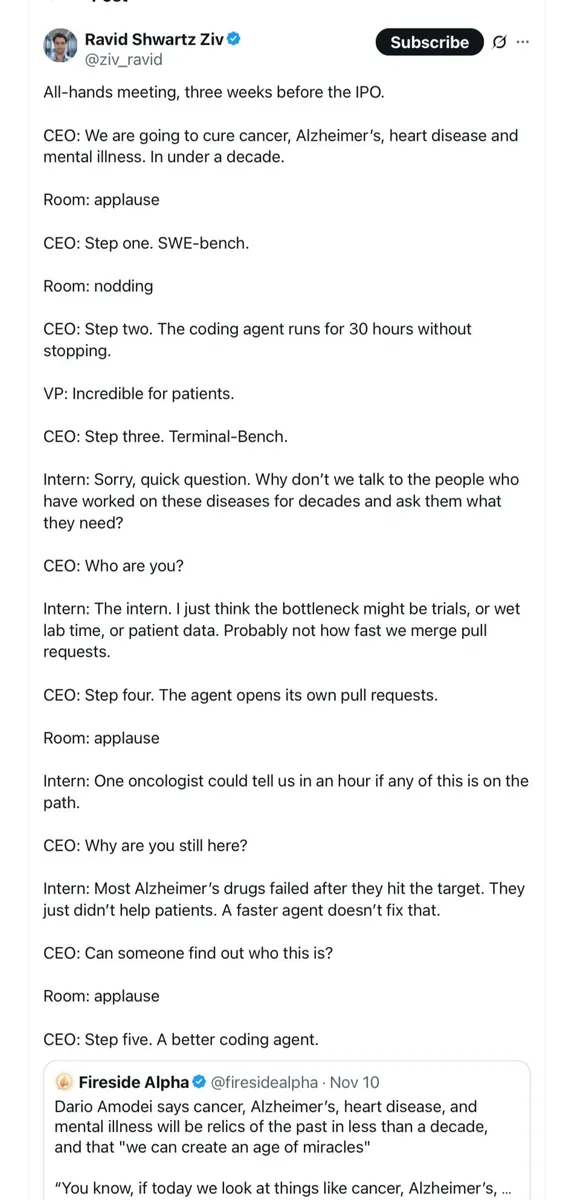
In a video released alongside the launch of Anthropic's IPO, CEO Dario Amodei predicted that cancer, Alzheimer's disease, heart disease and mental illness would be cured in less than ten years. As quoted by journalist Meg Tirrell, Amodei said: "Cancer, Alzheimer's, heart disease, mental illness - these will be relics of the past in, I think, less than a decade." He also suggested that "we can create an age of miracles." The remarks, made between 10.11.2026 and 12.11.2026, drew swift criticism on X, which writer Gary Marcus collected in a post published on 12.11.2026.
Marcus argued the timeline is not realistic: cancer is not a single disease and eradicating it will take more than a decade, while the suggestion that mental illness could be cured that quickly is, in his view, fantasy. Several respondents compared the claims to Elizabeth Holmes and Theranos. Geoff Shullenberger wrote that anyone who cannot see parallels with Holmes is beyond convincing, and journalist Charlotte Alter asked how Amodei saying AI "can" cure cancer differs from Holmes saying Theranos "can" test blood, noting that both use "can" to mean something may one day be possible. Epidemiologist Angela Rasmussen posted sarcastically: "We can test for every disease on earth with a single drop of blood." Alheli Picazo wrote that this is not how mental illness works and that the more fantastical the promises these CEOs make, the stronger the case against trusting them or their products. John Cassidy remarked, also sarcastically, that AI would cure mental illness within a decade.
Other critics focused on missing data and clinical timelines. Rich Law wrote that data exists for less than 1 percent of biology, that AI will probably help produce a few better drugs slightly faster and more efficiently, and that — especially given the five to eight years needed in the clinic — Amodei's statements amounted to exaggeration. An account posting as masterlongevity noted that for the 20 most recently approved drugs, the mean time from first-in-human testing to FDA approval was 14 years and the median 10, so unless such drugs are already in clinical testing or very close to it, the answer is no; the poster did concede there is a shot for AI. Rod Wong, MD, described himself as an AI bull who believes timelines will get much shorter but pointed out that the process has steps that cannot be skipped, such as mouse experiments, manufacturing, FDA interactions and clinical trials. Nicolas Kirchuk, who identified himself as CEO of a precision oncology company, wrote that clinical timelines alone make a cure in under a decade very hard — a drug entering trials today reaches patients in the 2030s — and argued a realistic outcome is turning advanced cancer into a chronic disease people live with, like HIV. Stephen Davis, identifying himself as a lifelong cancer biologist in the pharmaceutical industry, flatly rejected the claim.
Some pushback came from researchers Marcus characterized as pro-AI. Eric Topol called it an unattainable objective, writing that he wished it would come true but that curing all these diseases in the next ten years is impossible, while stressing he is very optimistic about AI's impact on health. Dave Ricks, chairman and CEO of Eli Lilly, replied to Tirrell: "I think that would be amazing and I think it's not likely. The map of biology is still largely a blank page and randomized human proof is the long pole in the tent. I am excited about the use of AI in our sector but progress will likely be steady and incremental."
Philosophy professor Megan Fritts placed the remarks in a broader context, describing Amodei and his peers as cult leaders simultaneously playing doomsday, healing-miracle, secret-knowledge and messianic angles, and calling that strategy effective. Because the predictions were made in a video tied to Anthropic's IPO, several responses addressed the fundraising context: Rami Elghandour, who wrote that he has taken two companies public, called them "insane things to say in an IPO pitch" that reek of desperation. Marcus himself posted that Amodei's IPO speech was as dishonest as anything Elizabeth Holmes ever said and that some investors never learn.
Marcus closed by noting that, despite the widespread ridicule, he had not noticed a single major-media article deconstructing the claims, and argued that in failing to challenge the remarks the media is failing the American public; in his opinion the statements are so egregious they should be investigated for securities fraud. He ended with a postscript saying readers might need a little technical background in software development to follow an appended cartoon, which in his view captured the situation better than Dilbert.