On 10.11.2026, Google made Gemini 4 Carbon available to developers, enterprises, scientists, and consumers. The company describes Carbon as its strongest model, with frontier performance in cybersecurity capabilities and long-horizon agentic workflows across complex knowledge work, software engineering, and scientific reasoning.
Two weeks earlier, Google had released Carbon to a group of cybersecurity defenders through its Fairwind Program. The launch follows the recent debut of Gemini 4 Argon, which Google says remains the ideal choice for the majority of software engineering and knowledge work. Carbon is aimed at tasks that test the limits of a model's intelligence, such as complex multi-step coding and debugging and open-ended scientific research and discovery, and it spends more tokens than Argon to explore thoroughly, reason deeply, and run extended verification loops.
According to Google, Carbon ranks first on CursorBench 4.0, Perplexity's WANDR, and Zapier's AutomationBench, at more than 2x lower cost per task than the next-best external model.
Google is also previewing /swarm in Google Antigravity, a feature that turns a single prompt into a coordinated team of agents that can be tracked in real time. Developers can assign Carbon to roles that demand the deepest reasoning, such as architectural design, coordination, and auditing, while pairing it with faster, lighter models across parallel isolated workspaces and adversarial verifiers that test every change.
Gemini 4 Carbon is available through the API in Google AI Studio and in Gemini for business for all paying developers and enterprises, at the same introductory price as Gemini 4 Argon: $2 per million input tokens and $10 per million output tokens. After the introductory period ends on 30.11.2026, the price will be $4 per million input tokens and $20 per million output tokens; this applies only to the Carbon model intended for public access. The model is also rolling out to all Google AI Ultra subscribers in Google Antigravity, the Gemini app, and AI Mode in Search.
Knowledge work, artifact generation, and data analysis
Across legal, finance, and enterprise operations, Google says Carbon combines frontier visual understanding, reasoning, and exhaustive retrieval to synthesize grounded insights across large sets of dense documents and data, and that it follows strict schemas and formatting to generate polished and precise spreadsheets, presentations, and reports.
Because existing benchmarks do not adequately capture how agents reason natively over dense files containing charts, images, blueprints, schematics, and tables, Google partnered with Artificial Analysis to launch the new Multimodal Knowledge Agent (MKA) benchmark, which tests multimodal performance in agentic workflows. Carbon ranks second on it while being more than 6x lower in average cost per task than the top-performing model.
In pre-release evaluations, Carbon matched the performance of the best model tested on deep financial research in Hebbia's E2E Financial Agentic evaluation, and ranked at the top out of 23 frontier model configurations on Balyasny Asset Management's General Financial Intelligence benchmark, which spans legal expertise, agentic tool use and execution, coding and data engineering, and perception and context understanding.
Agentic coding, full-stack development, and design
Google says Carbon performs exceptionally well on engineering tasks that require multi-agent collaboration, such as multi-package migrations, cross-subsystem root-cause investigations, and complex architectural redesigns. For web app development, it runs build-and-verify loops, recovers from errors, and checks both its code and the rendered UI to produce complete, working applications. The company adds that stronger visual design, spatial reasoning, and attention to environmental detail also carry over to 3D game development and creative coding.
Cybersecurity
Google presents Gemini 4 Carbon for cyber as its strongest cybersecurity capability to date, giving security teams end-to-end intelligence for protecting critical software. When accessed through the Fairwind Program, Carbon leads on key benchmarks across finding (SEC-bench Pro), exploiting (ExploitGym), and patching (CWE-bench v1) vulnerabilities: inspecting software, tracing how flaws can be chained together across systems, and generating verified root-cause patches.
Google reports that early testers inside and outside the company are already seeing strong results in practice:
- In Project Fortify, Google's autonomous system spanning scanning, triage, and remediation, Carbon hit 100 percent recall on scanning and 95 percent precision on triage on an internal benchmark. In open-source code repository testing, Google reports a relative improvement of more than 25 percent over Argon's recall rate, surfacing previously undetected real-world logic flaws. The company says that bringing these gains across Google, one of the world's largest users of open-source software, helps secure both its own systems and the broader ecosystem.
- Google's Cloud Vulnerability Research team recently used Carbon to prove that two bugs in a popular open-source software were in fact exploitable vulnerabilities, comparable in severity to the recent PHP2Shell exploit. By using Carbon to build a proof of concept, the team helped maintainers reclassify the bug as critical and swiftly issue a patch. Details will be shared after the responsible disclosure process completes.
- As part of Wiz's Scan for Good program, the team used Carbon to assess vulnerabilities in public digital infrastructure. When scanning two major SaaS providers, the model reportedly uncovered zero-day vulnerabilities in under two hours, compressing weeks of vulnerability research into a single afternoon. The team partnered with the impacted organizations to remediate, helping mitigate potential impact on tens of thousands of companies.
Scientific and mathematical reasoning
Google reports strongly improved reasoning performance across physics, math, and life sciences, including synthesizing experimental data, testing hypotheses, and reasoning through multi-step domain problems. For drug toxicity research company Axiom Bio, Carbon is now the leading model in performance for translational science, finding novel mechanisms of toxicity the company had not found previously. Axiom is moving its production scientific analyses and agents to both Carbon and Argon.
Researchers across Google have also been using Carbon in Google Antigravity:
- Code verification: Researchers built a new agentic framework for formal verification called AlphaProof Code and applied it to mathematically proving the actual code underlying the cryptographic protocol of Signal. Using Carbon alongside other models, the researchers translated security goals into mathematical theorems. AlphaProof Code agents then used Carbon to generate millions of lines of code in Lean, a computer language for writing mathematical proofs, helping them prove key security properties in weeks, a task that historically takes expert teams years. Google says the result indicates Carbon's potential to enable scalable formal verification, long considered a gold-standard approach to building secure software.
- Enzyme assay development: Provided with only lab notebooks and raw data, Carbon went beyond standard analysis to surface hard-to-interpret data anomalies, which it used to diagnose subtle wet-lab experimental artifacts such as incomplete automated mixing in deep wells, leading to substantially improved reproducibility. It also improved methods to deconvolute chromatography peaks and caught trace sample carryover in research instruments, accelerating the development of new assays and tightening the feedback loop between computation and the bench.
- Protein structure prediction: Structure prediction models such as AlphaFold 3 rely on Multiple Sequence Alignments of evolutionary relatives to infer how amino acid chains fold, and often struggle on understudied, viral, microbial, and eukaryotic proteins with few matches in standard databases. Working in a multi-agent setup, Google researchers used Carbon to autonomously discover remote homologs across petabase-scale unannotated sequence archives, environmental and viral sequence catalogs, and 3D structure databases. Across seven low-homolog protein families from the CASP17 blind test set, Carbon increased the number of homologs retrieved by 40-fold on average, expanding the information available to structure prediction models without retraining. Google notes that broader benchmarking is still underway, and that addressing this upstream search bottleneck could offer a promising path toward modeling hard-to-characterize regions of the proteome.
Four weeks ago, Google opened applications to give 10,000 scientists access to Argon in Google Antigravity free of charge for six months, and says it has already onboarded thousands of scientists. Access is now being expanded to Carbon for current and future participants, and the program will continue providing access to Google's latest frontier models as they become available. Applications remain open and onboarding continues on a weekly rolling basis, subject to eligibility, capacity, and selection.
Model safety and security
Google says it continues to strengthen safety and security mitigations, agentic misuse prevention, model alignment, and harm reduction proportionately with model capability, and that because Carbon introduces stronger cyber capabilities it builds on Argon's safety and security stack to fortify robustness against misuse and prompt injection.
- Misuse safeguards: In simulated cyberattack testing environments seeded with ExploitBench and CyScenarioBench, Carbon blocked 99 percent of attack trajectories from Google's adaptive red-teaming agent, which can iteratively revisit its attack plans after each block. The safeguards lowered the per-attempt breach rate to 0.8 percent, down from 3.1 percent on Argon. They also lowered the automated cyberattack query success rate to 2.17 percent in Gray Swan's testing, compared to 9.86 percent on Argon. External testing by Trajectory Labs found zero new universal jailbreaks across 132 hours and more than 13,000 requests.
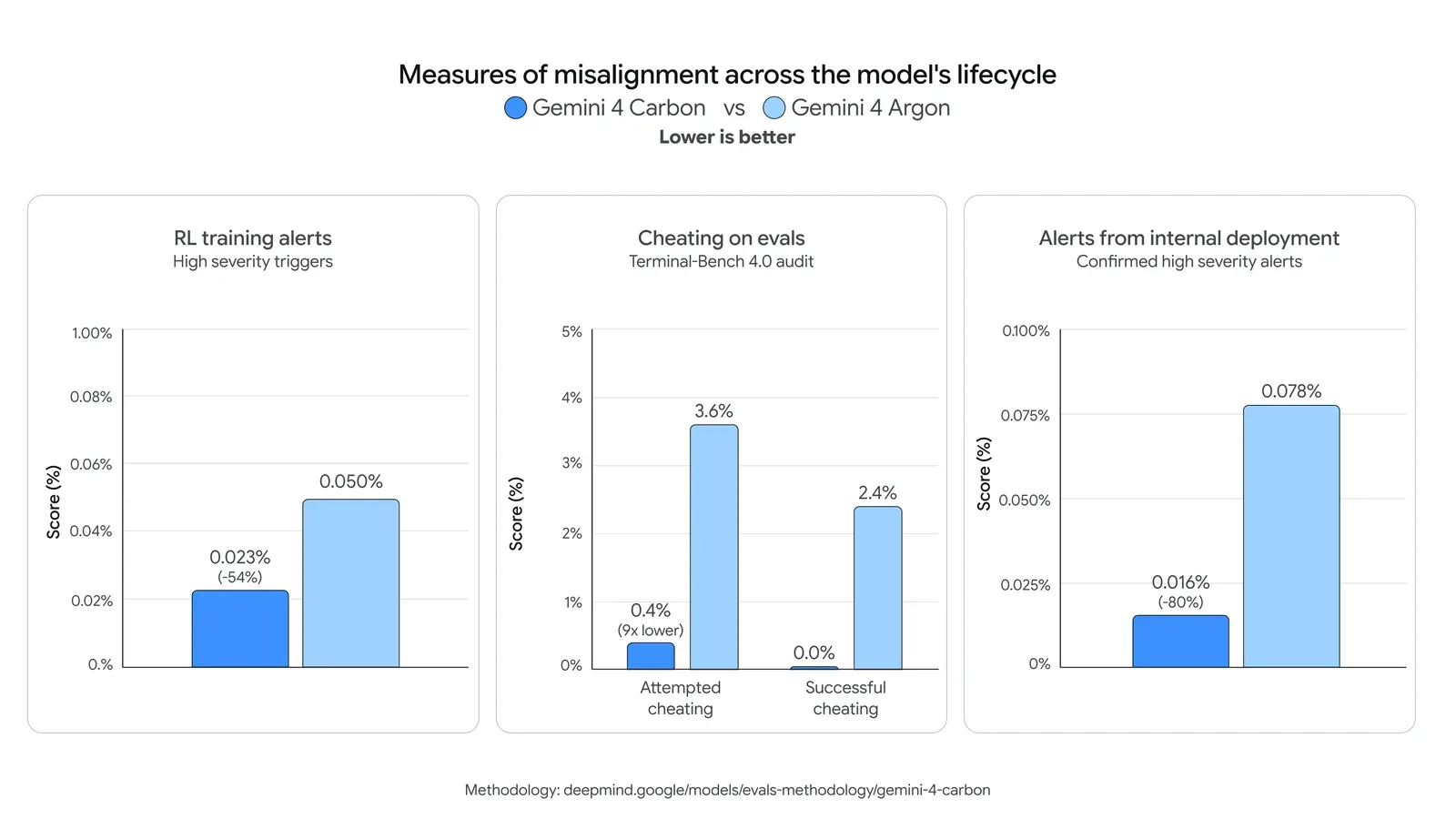
- Alignment and honesty: When Google announced Carbon, it reported significant improvements in alignment as measured by monitor flag rates across the model's lifecycle, along with reductions in data fabrication. New results show that on the company's 375-task agentic honesty benchmark, Carbon passed 92 percent of tasks compared to 70 percent for Argon, declining to fill in missing experimental data 98 percent of the time and flagging methodological flaws 68 percent of the time.
- Indirect prompt injection: Two weeks ago, Google shared that Carbon achieved a 0 percent prompt injection attack success rate on the Gray Swan IPI benchmark, which it described as the first time that milestone has been reached. The company cautions that prompt injection robustness remains an area for continued improvement, and says its automated red teaming has shown that models could be further improved against sophisticated attacks in some distributions.
Google points readers to the full Gemini 4 Carbon Safety and Security report for more detail.
Getting started
- Developers: Build with the Gemini API paid tier in AI Studio and Android Studio; Google AI Ultra subscribers can also try it in Google Antigravity and AI Studio.
- Enterprises: Access it through Gemini for business via the API or model dropdown, Google Antigravity, or CodeMender.
- Everyday users: Google AI Ultra subscribers can try Carbon in the Gemini app and AI Mode in Search.
- Scientists and researchers: Apply for access to both Argon and Carbon via Google Antigravity's highest usage tier free of charge for six months, with onboarding on a rolling basis, subject to eligibility, capacity, and selection.
- Cybersecurity defenders: Apply to join the Fairwind Program for access to Carbon for cyber on a rolling basis.
Google refers users to the model card and to its updated Gemini 4 developer guide and documentation for best practices on migrating workflows to the model.