Amplitude has built its business on showing teams how people actually use their products, and its proactive product agent, Wave, is designed to turn those insights into shipped changes. According to Amplitude, Wave runs on OpenAI models for roughly 80% of its workload, drawing on GPT-6.1 Sol, GPT-6 Luna and GPT-Image-2.5 Flare. The agent converts product findings into implementation plans that teams can pass to coding agents, including Codex, and then measures the results. Amplitude estimates that with Wave, teams can ship product improvements in one to two days instead of roughly a month.
"AI can now find useful work we never thought to assign it. OpenAI's models can investigate a problem, write and run code, and use the results to decide what to try next," said Spenser Skates, CEO of Amplitude.
From product data to shipped improvements
Teams point Wave at a product area together with the goals and metrics they want to move. The agent combines Amplitude data, session replays, customer feedback and code to surface and prioritize opportunities, develop solutions and coordinate implementation with both people and coding agents. It then tracks outcomes and feeds what it learns into the next round of improvements.
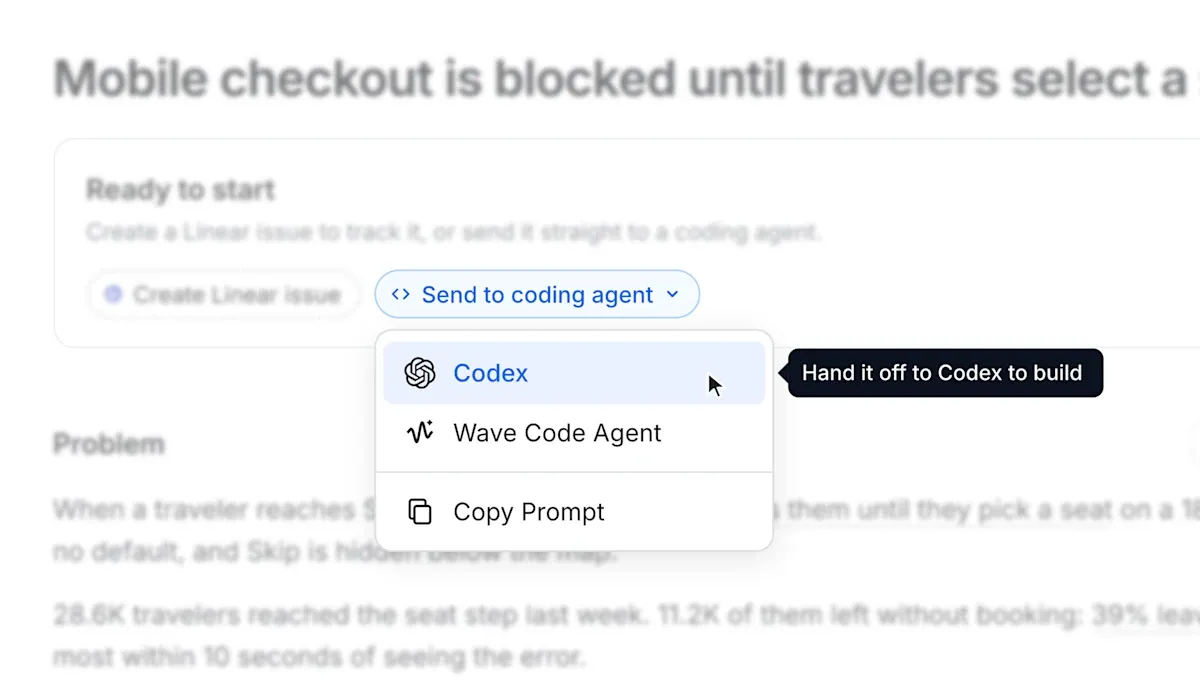
Amplitude assigns different OpenAI models to different parts of that workflow. GPT-6.1 Sol powers the opportunity manager and deep investigations into code and data. GPT-6 Luna covers frequent, lower-cost jobs such as scanning code and running small evaluation checks. GPT-Image-2.5 Flare produces product mockups, using screenshots captured from session replays as visual references. Once an opportunity is ready to build, teams can send it from Wave straight to coding agents, including Codex, along with a technical plan and acceptance criteria.
How Wave produced a 160% lift in agent engagement
"The idea with Wave is you have a unified platform with agents that comb through massive amounts of session replays, analytics, and code to find opportunities to improve products," explains Jacob Newman, Principal AI Product Manager at Amplitude.
Amplitude tried Wave on its own homepage, where generic suggestion cards were supposed to help visitors start a conversation with an AI agent. Wave found that users largely ignored them: in a sample of 100 session replays, 80 people typed their own questions while only 12 chose one of the suggestions.
The agent proposed personalizing the cards based on a user's recent charts, dashboards or the page they had arrived from. It produced an illustration of the change plus a technical plan that kept free typing intact and fell back to generic suggestions whenever personalization context was missing. After a short review, the team handed the work to a coding agent and ran an A/B test.
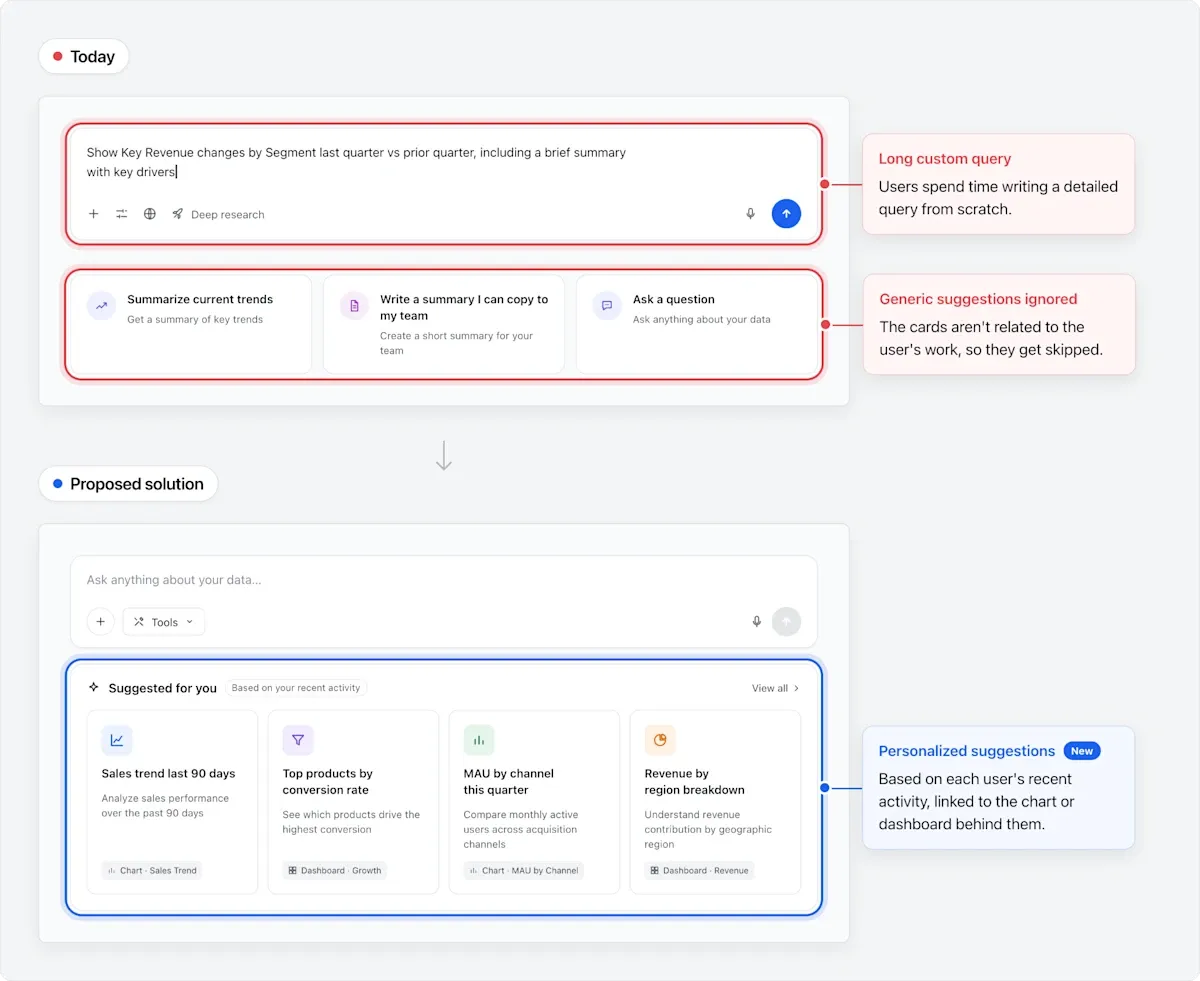
In the experiment readout Amplitude shared, messages sent through the homepage suggestion cards rose 160% relative to control after one day. "It is a great example of how non-groundbreaking things that just get ignored can increase the adoption of features in unexpected ways," explains Eric Carlson, Senior Principal AI Engineer at Amplitude.
Choosing the right OpenAI model for each task
Wave's jobs place very different demands on its models: a deep investigation calls for strong reasoning and well-supported conclusions, while a small check repeated hundreds of times has to be fast and cheap. Amplitude evaluates quality, latency and cost for each task and assigns models accordingly.
"OpenAI gave us both strong reasoning models and smaller, faster models, so we could balance quality, latency, and inference cost across the product," said Skates.
For Wave's Opportunity Investigator, Amplitude assessed whether models corroborated findings, avoided false positives, incorporated evaluator feedback, recovered from tool failures and kept claims aligned with evidence. GPT-6.1 Sol earned an overall score of 4.06 out of 5, against 3.62, 3.52 and 2.94 for three alternative models. It led on all five investigation criteria and posted the fastest median investigation time at 54 minutes.
In a separate evaluation of Wave's Data Science Agent, GPT-6.1 Sol scored 67.5 out of 100 compared with 69.3 for another leading model, while its mean model cost was $1.28 versus $2.63 per dispatch. GPT-6.1 Sol also scored higher on tool-contract compliance, estimation and uncertainty, and evidence grounding.
For high-volume work such as scanning code and running small evaluation checks, Amplitude relies on GPT-6 Luna to hold latency and cost down. Spreading tasks across specialist agents lets the team reserve the more expensive reasoning for the work that needs it. For wireframes and mockups, OpenAI's image generation model scored 80.3 out of 100 on solution wireframes versus 63.9 for another image generation model; the evaluation covered communication quality, product fidelity, instruction adherence, text and UI legibility, and visual coherence across 15 opportunities.
Keeping teams in charge of what ships
Wave is in beta, and customers across industries are already using it to find and ship product improvements. The agent analyzes session and analytics data, then develops recommendations that arrive with a proposed fix, a technical plan and acceptance criteria.
Teams decide how much automation they want. Amplitude says most send bug fixes straight to coding agents, while new features and bigger bets get a human review. Where changes do reach launch, the route from discovery to execution can be short: among customer-launched experiments, flags and guides, one in four went live the same day Wave surfaced the opportunity, half were live in under four days and two in three within a week. The company presents those figures as milestones on an illustrative curve rather than individual observations.
What is next
"Our ambition with OpenAI is to make self-improving products the way companies build software," says Skates. As OpenAI's models improve at reasoning and coding, he expects teams to hand more investigation and implementation work to agents, which he believes will get better products to users faster. Amplitude says it is already seeing that pattern, with agents finding and helping deliver improvements in its own product while the team works on other priorities: "I think teams will be surprised by how much they can accomplish when their software is working alongside them to make the product better."