A team at the Shanghai Artificial Intelligence Laboratory has introduced Sage-Taiyi, a metacognition-inspired architecture designed to regulate how an AI system searches for scientific ideas. The work is described in arXiv paper 2611.12762v1 [cs.AI], dated 9 November 2026, authored by the Sage-Taiyi Team.
Architecture
Sage-Taiyi divides scientific discovery into two levels, drawing on the Nelson and Narens account of metacognition as monitoring and control of one's own cognitive processes.
At the object level, the system carries out scientific search for a research question. Its state consists of three structures: a Target Tree that decomposes the research question into targets, subtargets, and local strategies; an Idea Graph that records ideas and their transformation lineage through five operations (Merge, Fuse, Diverge, Repair, and Evolve); and an Evidence State that retains experimental and computational results, literature knowledge, and expert input with their sources.
At the meta level, two resources regulate that search. A task-specific Cognitive State maintains a selective representation of object-level scientific understanding alongside monitoring-derived assessments of evidential support, unresolved conflicts, and shared dependencies across ideas. A reusable Cognitive Repertoire stores ten methodological heuristics, including evidence-driven discovery, analogical transfer, inverse design, and bottleneck-driven redesign, together with Cognitive Operators organized by function into Framing, Constructing, Evaluating, and Learning. Domain instantiation adapts these general entries to specific fields using literature, and feedback learning refines them from task outcomes.
Monitoring interprets search outcomes to update the Cognitive State; control uses the updated state and the repertoire's applicability conditions to decide which target or idea to address, whether to continue, revise, redirect, or stop a branch, and which methods to apply. A research harness translates control decisions into tasks, invoking ideation or proceeding to execution and validation, with results returning to the Evidence State. Domain experts participate in idea selection and validation, and a component called Taiyi-Optimizer searches specified condition or design spaces.
Benchmark results
The authors evaluate Sage-Taiyi on Taiyi-Bench, an AI co-scientist ideation benchmark they constructed comprising 265 tasks derived from 50 papers across ten disciplines, including earth science, neuroscience, economics, physics, chemistry, and communication engineering. To reduce training-data contamination risk, the papers were first publicly disclosed on or after 1 March 2026, after the reported knowledge cutoff of the base model. Tasks progressively disclose established decisions reconstructed from each study, and evaluation combines historical rediscovery metrics with open-ended evaluation of novelty, effectiveness, feasibility, and diversity, scored by a literature-grounded verifier that the authors report agrees well with human expert judgments.
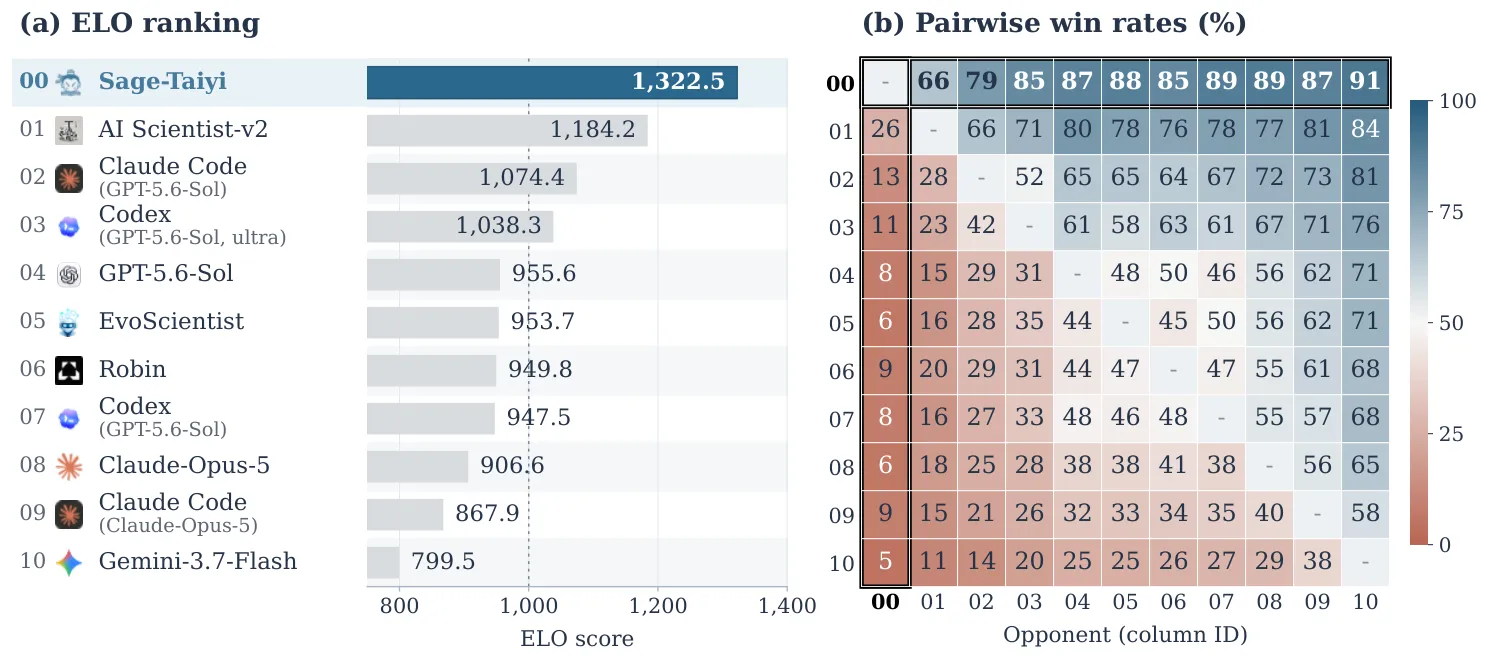
Sage-Taiyi, run on GPT-5.6-Sol at high reasoning effort with ten ideas requested per task, ranked first on all eight metrics, with Rediscovery and Open-ended group scores of 44.6 and 63.3 and an Overall score of 54.0, compared with 47.9 for the strongest baseline, AI Scientist-v2. Its largest advantage was on Novelty, 70.5 versus 55.2. In pairwise comparisons it obtained the highest Elo rating, 1,322.5, winning 66.3 percent of comparisons against AI Scientist-v2. Recorded generation time was 29.9 minutes per task, versus 39.3 minutes for AI Scientist-v2 and 44.8 minutes for Codex at the ultra reasoning setting. The comparison covered ten baseline configurations across direct generation, general-purpose harnesses, and scientific discovery harnesses, with the latter evaluated on ideation stages only.
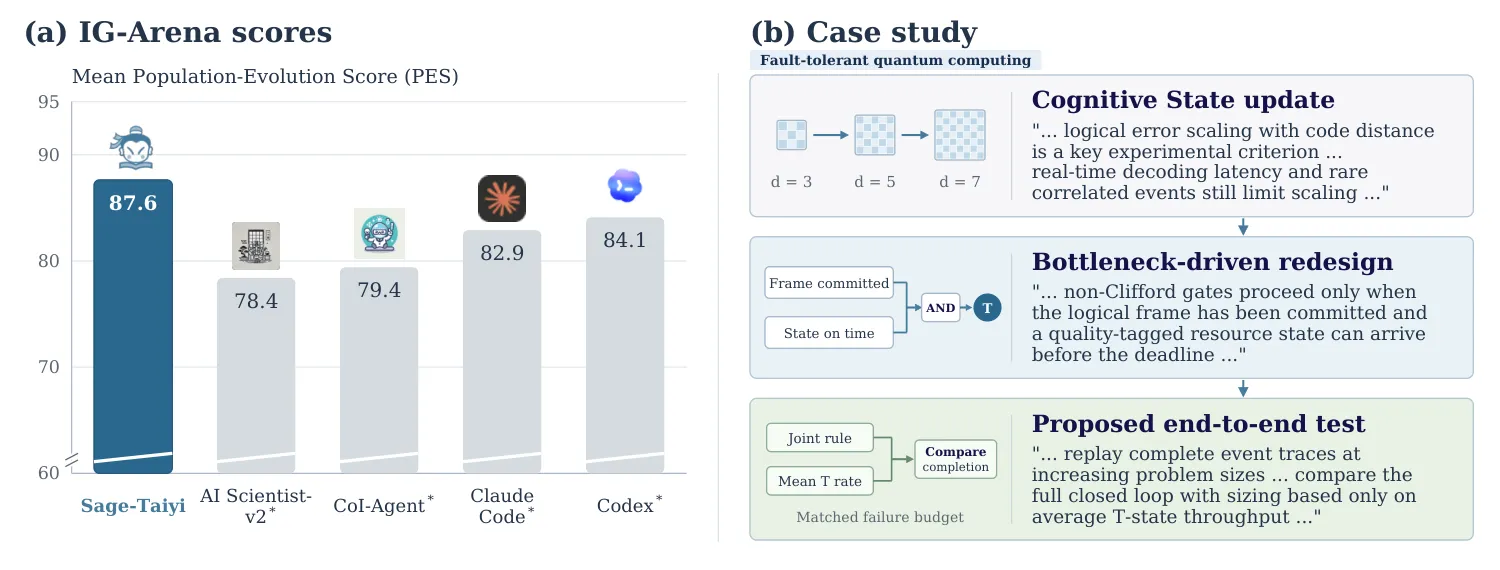
On two external benchmarks, Sage-Taiyi achieved a weighted mean of 7.195 on AgentIdeaBench across 40 subfields, compared with 6.852 for AI Scientist-v2, and a mean Population-Evolution Score of 87.634 on IG-Arena's 30 frontier questions. In both evaluations the system selected its own search queries and papers to consult.
Expert-guided collaborations
Five collaborations connected the system's proposals to experimental or computational validation:
- Metal catalysis: Sage-Taiyi proposed a cobalt-catalyzed carbonylation route to tetrasubstituted allenyl ketones, combining nucleophilic and radical carbonylation at a cobalt centre. Bayesian optimization of the condition space raised the model-reaction yield from trace amounts to 84 percent; the optimized conditions also produced derivatives from flurbiprofen, pyriproxyfen, and salicin precursors at 40, 74, and 86 percent yield.
- Photochemistry: For site-selective allylic amination with heteroaryl amines, the system proposed an aminium radical-cation addition followed by cobaloxime-mediated hydrogen atom transfer. Optimization raised the yield of the model reaction between 2-aminopyridine and a 1,1-disubstituted alkene from 13 to 69 percent.
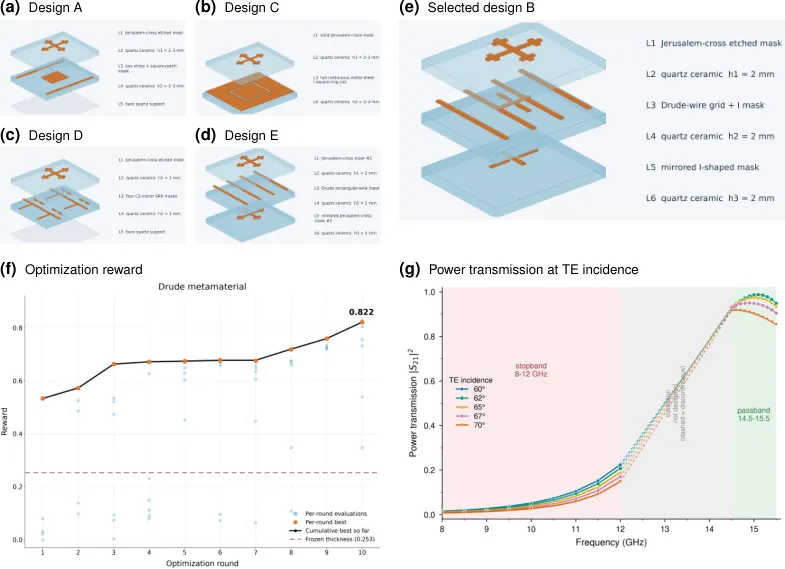
- Metamaterials: For a multilayer electromagnetic band-stop filter, optimization feedback led the system to identify a fixed substrate thickness as a bottleneck and recommend relaxing it. The revised search produced a design with simulated average transmission of 6.2 percent in the 8 to 12 GHz stopband and 94.5 percent in the 14.5 to 15.5 GHz passband, compared with 9.5 and 87.4 percent for an expert-designed fishbone reference.
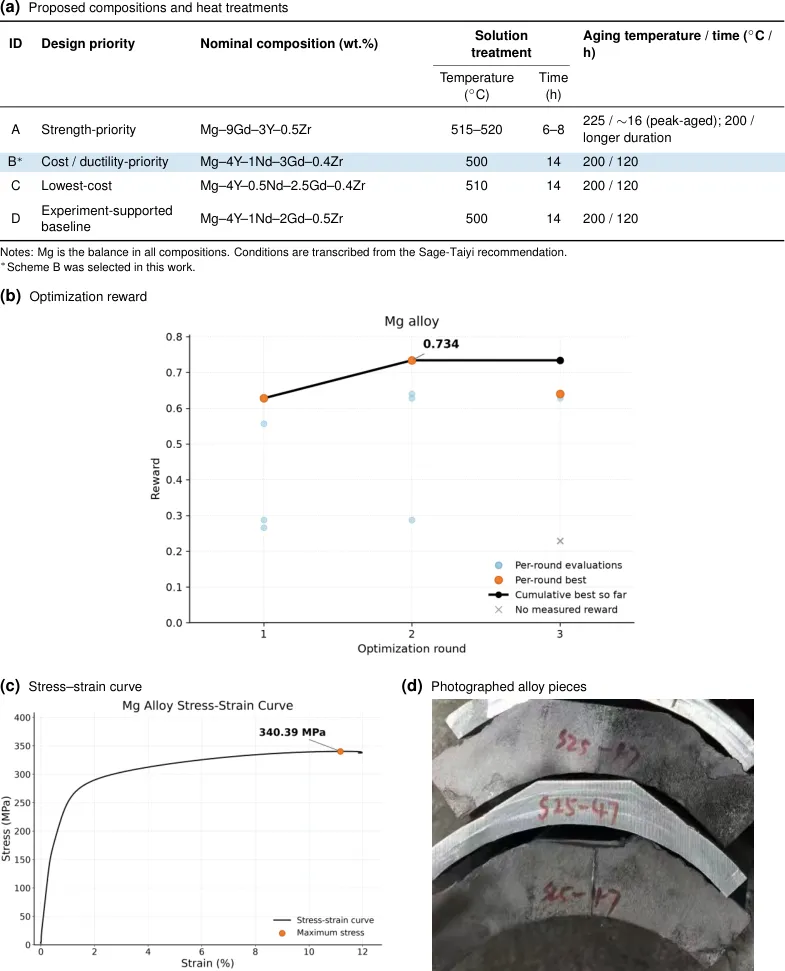
- Alloy design: Joint optimization of composition and heat treatment, starting from an expert-selected Mg–4Y–1Nd–3Gd–0.4Zr candidate, produced a cast magnesium alloy (nominal Mg–4Y–1Nd–2Gd–0.5Zr) with a mean measured tensile strength of 342 MPa across repeated tests.
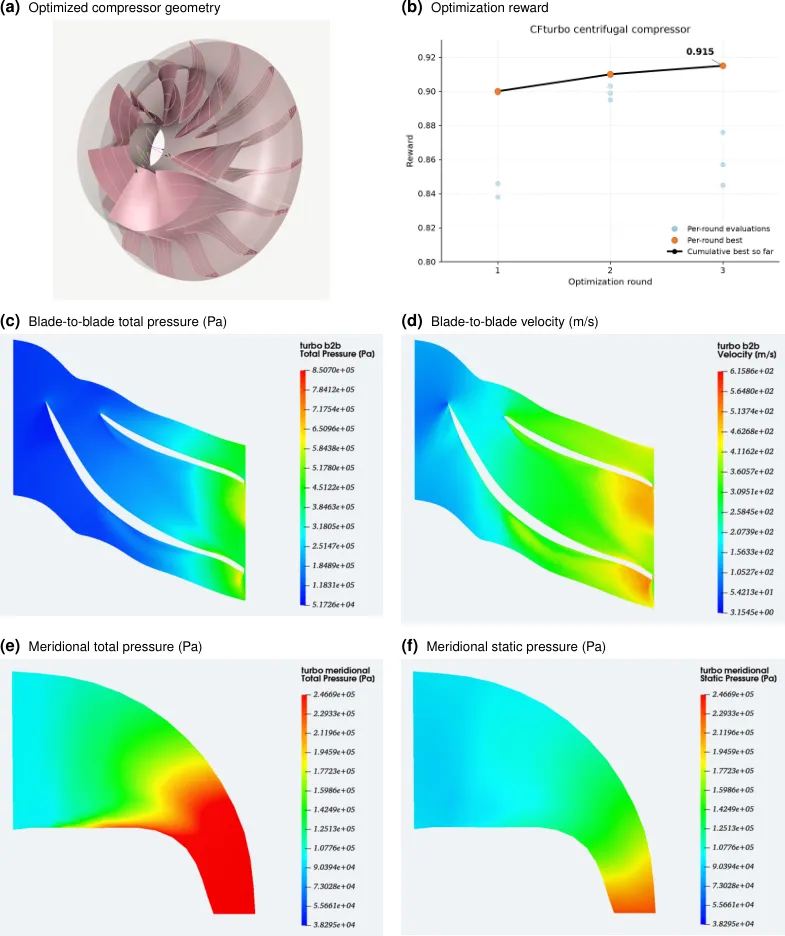
- Compressor engineering: Geometric refinement of a centrifugal compressor, guided by CFD evaluations, achieved an impeller efficiency of 91.5 percent at a pressure ratio of 4.0.
Reported limitations and scope
The paper frames these outcomes as the authors' reported results. Scores on Taiyi-Bench depend on a literature-grounded automated verifier, and the real-world outcomes were produced through expert-guided collaborations in which domain experts participated in idea selection and validation rather than fully autonomous operation. The authors describe the results as supporting metacognitive regulation as an approach to scientific ideation and its progression toward practical validation.