Google Deepmind has introduced AlphaGenome 2, an AI model built for genomics research that estimates how genetic variants influence particular human cell types. According to the company, it surfaces close to twice as many relevant gene changes as the original AlphaGenome.
Every cell in the human body carries an identical DNA blueprint, yet each cell type activates a different set of genes: a heart muscle cell interprets DNA differently from an immune cell. Predicting those differences remains one of the hardest open questions in genomics, and Deepmind presents AlphaGenome 2 as a significant step toward solving it.
The model is intended to forecast how DNA sequences and their variations shape the behavior of specific human cell types. Deepmind says it was trained on more than 107 million individual cell profiles drawn from 68 tissues in humans and mice, with the goal of helping researchers uncover the cellular drivers of disease.
A conditional model replaces the tissue-wide overview
The first AlphaGenome accepted a DNA sequence one million letters long and predicted its properties across thousands of experiments covering many tissues simultaneously. In Deepmind's account, that parallel design spread the model's capacity too thin and obscured fine distinctions between closely related cell types.
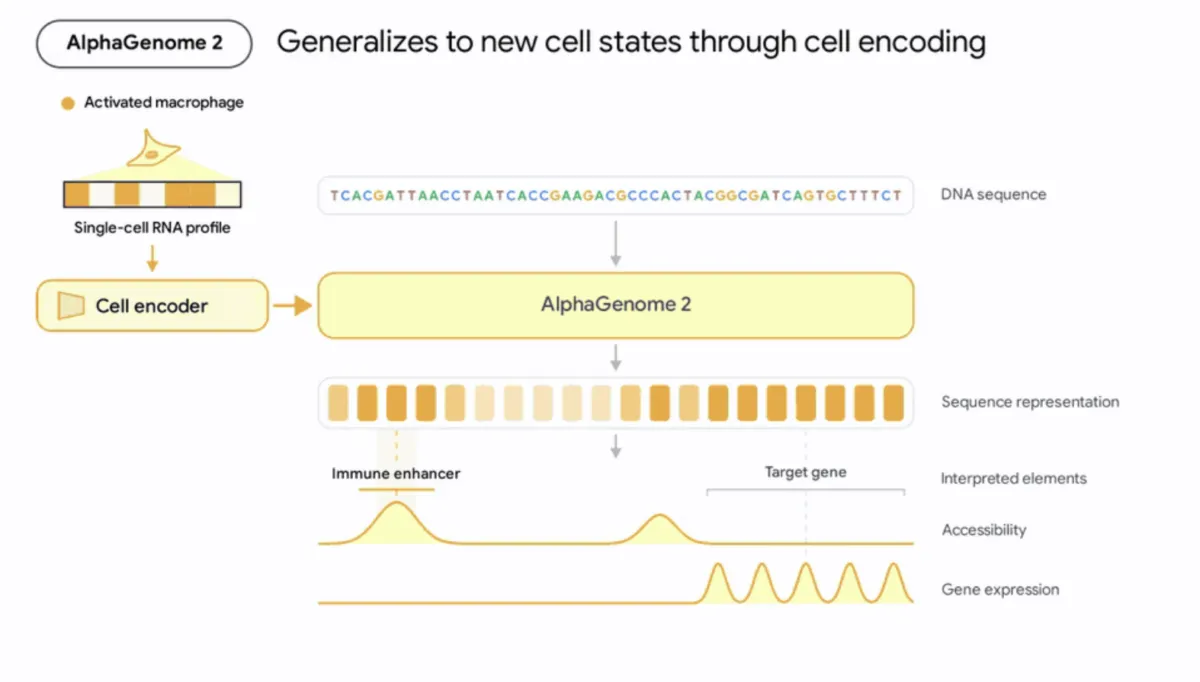
AlphaGenome 2 instead operates as a conditional model: alongside the DNA sequence, it receives a specific biological state as an additional input and computes effects for that single cell type. Beyond estimating how strongly a gene is expressed, the system also models how DNA is physically packaged inside the nucleus, revealing which stretches of the genome are accessible, and it can now predict DNA methylation, the chemical tags that act as molecular switches to silence or activate genes.
The model can also fill in missing measurements. If a lab measures only a cell's gene activity, for example, AlphaGenome 2 produces predictions for further properties such as how tightly or loosely certain stretches of DNA are packaged, which helps researchers decide which lab experiments are worth running next.
Sharper identification of disease genes and vaccine responses
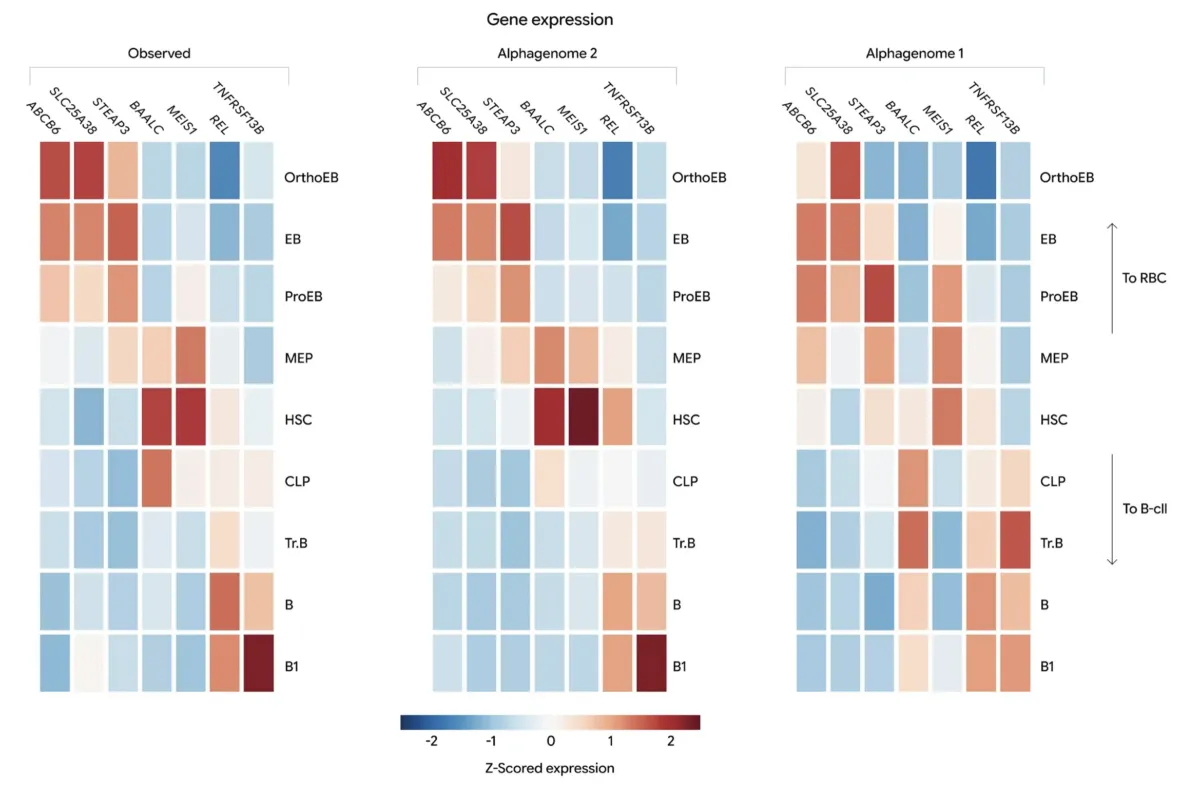
On the TenK10K benchmark dataset covering 28 primary immune cell types, AlphaGenome 2 flagged about 30 percent of causal variants, and in 43 percent of cases it also correctly predicted whether a variant raises or lowers gene activity. A fine-tuned version of AlphaGenome 1 managed only 16 and 23 percent on the same measures. The system also tracks continuous processes, such as the maturation of blood stem cells into red blood cells, with considerably better accuracy.
Working purely computationally, the model reproduced an inflammatory bowel disease mechanism that had previously been identified in a study. It isolated the exact DNA variant, located in a regulatory switch far from the gene itself, that selectively overactivates ETS2 in gut macrophages while other cell types and genes remained largely unaffected.
A key advantage of the new architecture, Deepmind says, is its ability to adapt to entirely new experiments without retraining. Researchers can feed in gene activity data from just a few dozen cells, and the model calculates effects for that previously unseen cell state; according to Deepmind, it often outperforms specialized models trained directly on that data.
Applied to data from a COVID-19 mRNA vaccine study, the model reliably distinguished vaccine-activated T cells from resting ones and showed that a gene variant linked to severe COVID-19 cases disrupts cell activity mainly in the activated state. In resting cells, that effect would have remained invisible.
Precomputed predictions, availability and limitations
Deepmind has already precomputed predictions for hundreds of cell and tissue conditions, in part to support AI-driven drug development. The precomputed predictions also help researchers analyze genome-wide association studies (GWAS), which link regions of DNA to traits such as height or type 2 diabetes but often only roughly locate signals within broad stretches of the genome. AlphaGenome 2 narrows down the likely causal variants and identifies the affected cell types, such as astrocytes in the brain or specific immune cells. When the model is confident enough, it also predicts whether a mutation increases or decreases gene activity, a capability described as important for drug development.
AlphaGenome 2 is available now for noncommercial research through an API, while commercial users gain access through a closed preview. The system is not approved for clinical diagnostics. Deepmind also plans to roll out dedicated AlphaGenome 2 features on its agentic development platform Google Antigravity, where the model is set to be combined with tools like Gemini 4 for automated research workflows.