Cinnamon is an AI agent built for households that was introduced in a Show HN post published on 12.11.2026. Its makers describe it as a service that plans, books, watches and reminds on behalf of one user and up to five people they trust, and that it always requests permission before it acts. The team says its members previously ran AI systems for billions of users at Facebook, Instagram and Amazon, and every new account begins with 25 free trial task credits.
The product is organized around three steps: Ask, Watch and Approve. Example uses listed on the site include planning a trip, where the agent can line up resorts, flights for four people and a shared itinerary that everyone can react to; producing a morning digest of inbox items that genuinely need a reply, with drafts ready to send; running a calendar of appointments, forms and renewals with reminders that land before deadlines rather than after them; and watching a price until it reaches a number chosen by the user.
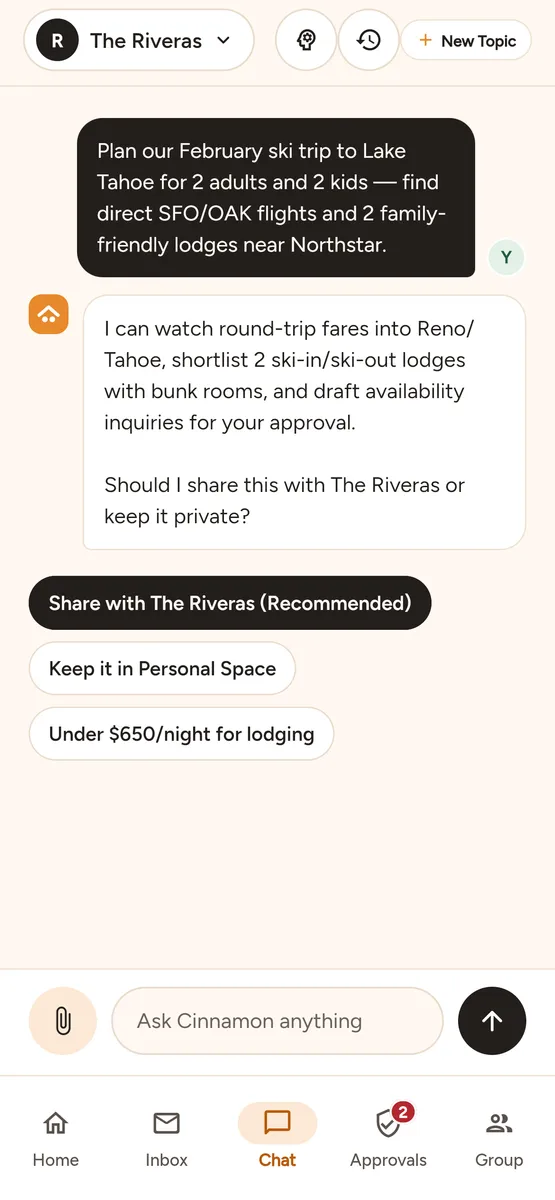
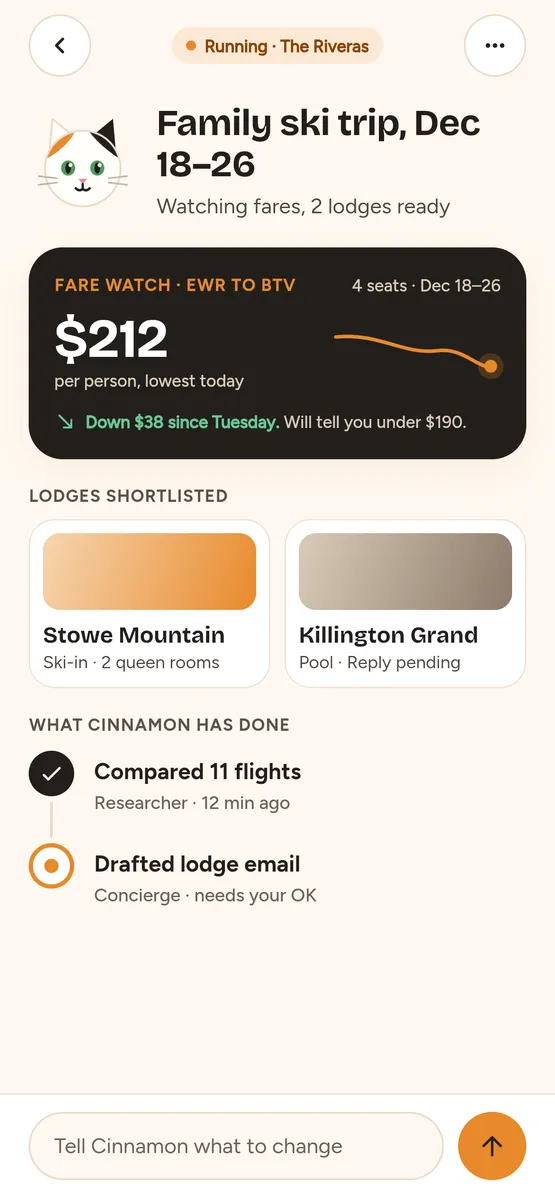
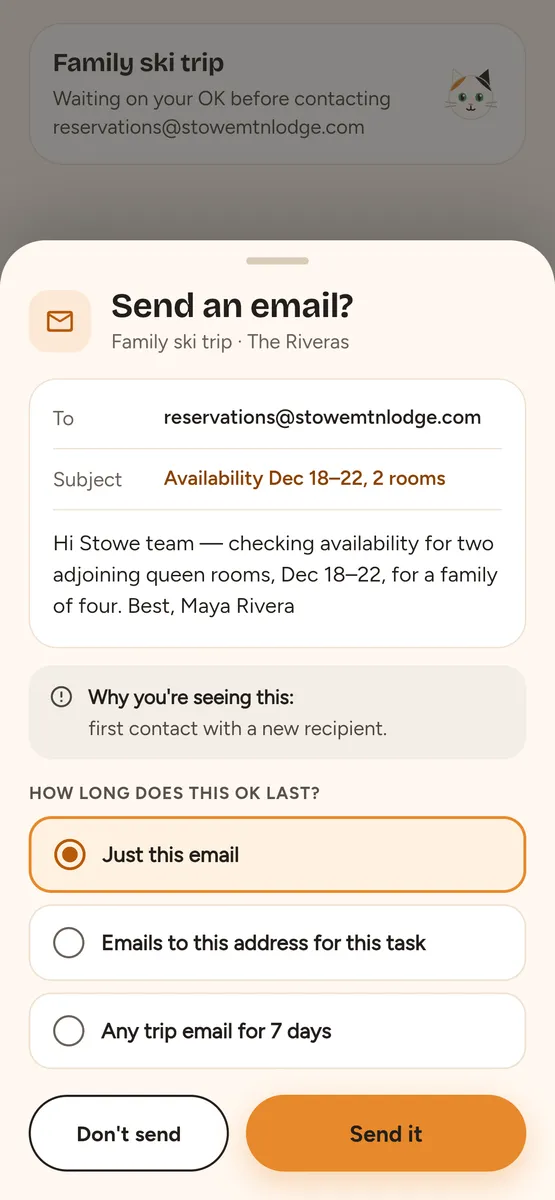
Accounts are divided into two spaces. Material placed in the household space — a ski trip, a chore rota or the Sunday digest, for instance — is visible to the whole household, while whatever sits in the personal space remains visible only to its owner. The company says Cinnamon never blends the two and always indicates which space is active. An on-screen cat serves as a status signal: open eyes mean a task is running, such as researching, comparing options or waiting on a reply, and closed eyes mean the task is finished or paused and that nothing happens without the user.
Rather than assembling a hidden profile from chats, Cinnamon stores what it learns as explicit facts. When the agent picks up a useful detail — the site gives examples such as a nut allergy, a home ZIP code or preferred airlines — it saves the item as a plain-English fact scoped to the space where it belongs: household facts stay with the family group and personal facts stay private to the individual. Users can inspect, correct or delete any saved memory, and every external step, whether an email draft, a calendar invite, a send, a booking or a purchase, stops for explicit approval first. The company also states that it runs no ads, never uses customer data to train AI models and keeps OAuth tokens vaulted where prompts cannot read them.

Pricing starts with a free trial of 25 task credits for every new account, with no credit card required to begin. The Personal Plan costs $9.99 per month for one member and includes 50 monthly task credits ($0.20 per credit) for research, planning and watchers, private isolated workflows and personal memory, recurring scheduled dispatches and continuous price monitors, plus Google Calendar and Gmail connectors; as on every tier, the agent asks before every send, booking or purchase. The Group Plan costs $19.99 per month for up to six members and provides 150 shared household credits per month ($0.13 per credit); the company calls this a Family Umbrella because one household subscription covers the shared group space and unlocks every member's private Personal Space for $0, with a single organizer bill so invited family members never enter a card, plus a de-duplicated household inbox, trip planning and daily digests. Group Plan Max costs $99.99 per month for up to ten members and provides 1,000 pooled credits per month at the lowest rate of $0.10 per credit, aimed at heavy daily dispatches, multi-trip logistics and continuous watchers, with multiple shared project spaces for trips, events or extended family, permanent household memory and priority support.
The product is named after a real cat. According to the team, Cinnamon is a feral calico that chose them: orange over one ear, black over the other, white everywhere else, with green eyes, and the cream, orange and black palette of the site is taken from her coat. The same cat communicates the agent's status in the interface — open eyes mean Cinnamon is working on something, and closed eyes mean the task is done or waiting and nothing proceeds until the user says so.

The founder and CEO is identified only as Michael. The site credits him with more than two decades of technical leadership building high-availability distributed systems, large-scale ML infrastructure and real-time consumer platforms, with an operational focus on privacy-preserving architectures, accelerator economics and dependable agentic workflows. At Meta, as a Technical Program Manager, he reportedly helped build the ML capacity modeling, forecasting and infrastructure framework spanning compute, storage, network and GPU capacity for Instagram and Reality Labs through global GPU constraints, supporting long-range planning and allocation decisions at the executive level. At Amazon Prime Video, as Principal Technical PM, he owned the roadmap and execution for a proprietary low-latency, globally synchronized live-event delivery protocol, aligning engineering teams in Seattle, Los Angeles, London and Stockholm that served tens of millions of concurrent viewers. He also co-founded Monitoreal, an edge-AI video analytics company whose computer vision appliances and multi-tenant cloud platform reached enterprise deployments at Portland International Airport, the NYC DEP and the NYC MTA, and Advection, a global CDN that the site says scaled to more than 1 billion streams per month across eight data centers while running 24×7 NOC operations, carrier peering and an engineering organization of more than 25 people. Listed patents cover object detection in video streams (US20200117905) and network metaswitch communications (US20010027491), and he holds a B.Sc. in Computer Science. The team argues that this background matters because household tasks involve real family calendars, medical appointments, school forms and utility bills, and says Cinnamon is architected with strict multi-tenant data boundaries, zero unauthorized cross-principal data leakage and a verified approval loop before any action is executed.
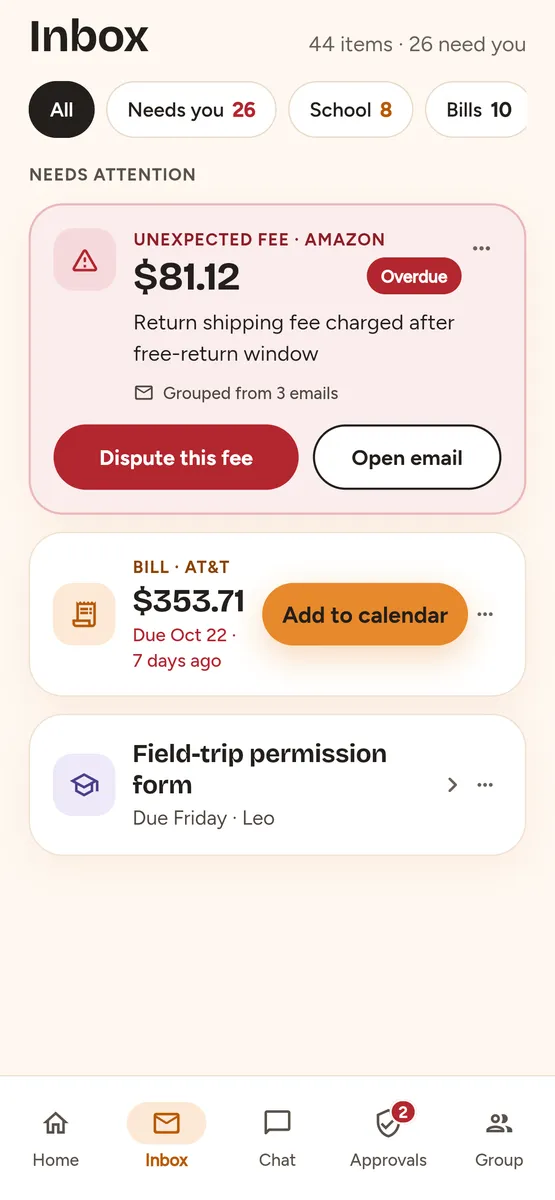
An FAQ on the site adds further detail. A household is not required: every account opens with a private space, and users can later invite up to five family members or close friends into a group whose shared tasks appear for everyone while the private space stays private. On data, the company says it stores the tasks Cinnamon runs together with the editable preference memory, does not retain conversation history once a session ends, and never keeps passwords or payment details anywhere Cinnamon can read them. Listed capabilities include monitoring and summarizing a connected Gmail mailbox — surfacing financial transactions, school notices, youth sports and other family activities — preparing draft inquiry emails in the Gmail Drafts folder when exploring options and contacting providers, checking the schedule and helping add important events to the calendar, researching and comparing products and local services, designing tailored meal plans and exercise programs, and helping prepare for job interviews. The company states that Cinnamon never sends emails on its own, never modifies the calendar directly and never spends money without the user's direct action. Asked why it offers no free tier like other assistants, the team answers that "free" usually means paying with personal data; Cinnamon is instead funded by the people who use it.